

Wall Art Size Guide 2026: How to Choose the Right Wall Art Dimensions for Any Room
Choose artwork size by proportion, spacing, and placement height. This guide shows the exact wall art sizing rules for sofas, beds, dining rooms, hallways, offices, triptychs, and large blank walls.
What size wall art should you choose?
The best wall art size is usually 60 to 75 percent of the furniture width below it. Above a sofa, bed, console, dining table, or desk, keep the artwork close enough to feel connected to the furniture. A reliable placement is a 6 to 8 inch or 15 to 20 cm gap above furniture and a visual center around 57 to 60 inches or 145 to 152 cm from the floor.
Artwork width = furniture width × 0.60 to 0.75. Use 60 percent for a quieter look and 75 percent for a stronger focal point. For high ceilings or large blank walls, move toward a larger statement format.
Choose artwork width around 60 to 75 percent of the sofa, bed, console, table, or desk width.
Place the artwork’s visual center around 57 to 60 inches or 145 to 152 cm from the floor, then adjust for furniture height.
Keep 6 to 8 inches or 15 to 20 cm between the furniture line and the bottom edge of the artwork.
Measure the total three-panel width, including the gaps, and treat it as one composition.

Five practical wall art sizing rules for choosing artwork dimensions by furniture width, spacing, and room scale.
How to choose wall art size without guessing
The correct wall art dimensions start with proportion. Artwork should respond to the room’s furniture, wall width, ceiling height, and visual weight. This creates a curated result instead of a small decorative object floating on the wall.
Rule 1: Match artwork width to furniture width
Start with width. A narrow print above a wide sofa or bed usually looks disconnected, even when the artwork itself is strong.
- 60 percent suits subtle, calm, lighter visual weight.
- 75 percent suits primary placements above sofas, beds, consoles, and dining tables.
- 75 to 90 percent suits high ceilings, wide walls, and statement layouts.
Rule 2: Use visual center height
When deciding how high to hang wall art, focus on the artwork’s visual center. In many interiors, the visual center should land around 57 to 60 inches or 145 to 152 cm from the floor.
Rule 3: Keep art visually connected to furniture
For wall art above a sofa or bed, the piece should not float too high. A 6 to 8 inch or 15 to 20 cm gap usually creates the strongest relationship between the furniture and the artwork.
Rule 4: Adjust for ceiling height
High ceilings increase the visual depth of the wall. Small artwork gets lost faster in tall rooms, so larger formats, wider compositions, and triptych wall art often work better.
Measure furniture width, multiply by 0.60 to 0.75, select the artwork height, align the visual center near eye level, then refine the gap above the furniture.
Wall art dimensions tables
Use these examples as a starting point. The final choice should account for ceiling height, visual weight, furniture height, room lighting, and the number of panels.
Artwork width as 60 to 75 percent of furniture width
| Furniture width | 60 percent artwork width | 75 percent artwork width |
|---|---|---|
| 140 cm or 55 in | 84 cm or 33 in | 105 cm or 41 in |
| 160 cm or 63 in | 96 cm or 38 in | 120 cm or 47 in |
| 200 cm or 79 in | 120 cm or 47 in | 150 cm or 59 in |
Quick hang zones above furniture
| Placement | Recommended gap | Best use |
|---|---|---|
| Wall art above sofa | 6 to 8 in or 15 to 20 cm | Modern living room focal point |
| Wall art above bed | 6 to 8 in or 15 to 20 cm | Bedroom wall art sizing |
| Wall art above console or sideboard | 6 to 10 in or 15 to 25 cm | Entryways, dining rooms, and transitional walls |
Living room wall art size guide
For living room wall art, the goal is architectural balance. The artwork should anchor the sofa area and create a clear focal point, not sit as a small detached accent.
Best wall art size above a sofa
- Width: choose 60 to 75 percent of sofa width.
- Gap: keep 6 to 8 inches or 15 to 20 cm above the sofa back.
- Centering: center the composition to the sofa, not necessarily to the whole wall.
- High ceilings: move toward wider formats or a structured triptych.
Living room scale examples
For a 79 inch or 200 cm sofa, a strong artwork width sits around 47 to 59 inches or 120 to 150 cm. For a smaller 63 inch or 160 cm sofa, aim around 38 to 47 inches or 96 to 120 cm. If the sofa sits on a large blank wall, use the upper end of the range to avoid a weak focal point.
If the room has side tables, floor lamps, or tall plants near the sofa, keep the artwork visually centered to the main seating zone. The wall composition should still feel aligned to the sofa, even when the full wall is wider than the furniture.
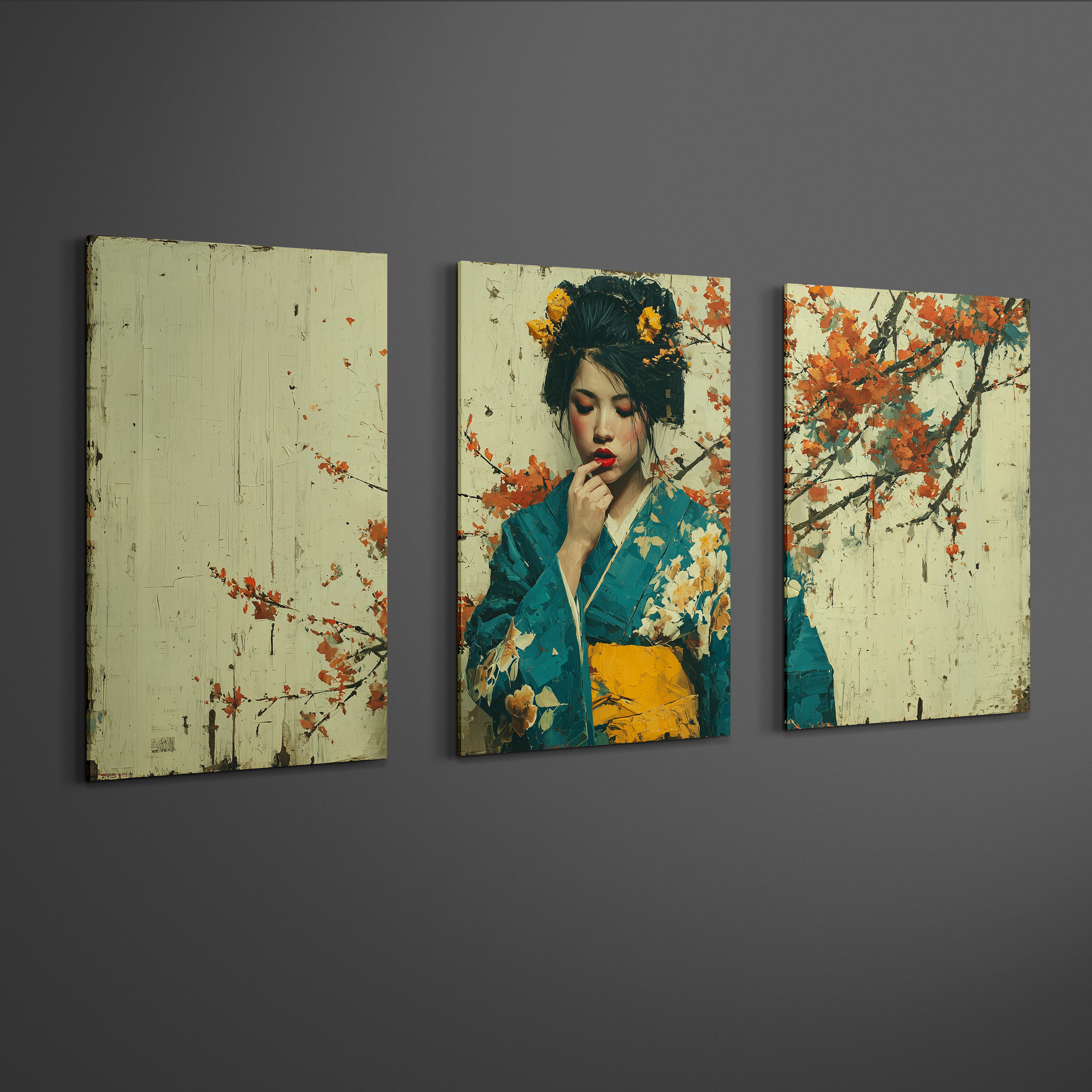
Japanese wall art works best when the complete composition is scaled to the sofa, especially in Japandi and minimalist interiors.
Japanese wall art for living room sizing
If you are selecting Japanese wall art for a living room, treat the artwork as a structured focal point. For a triptych, measure the full width of all three panels and gaps, then match that total width to the sofa.
For three-panel layouts, explore our triptych wall art collection and our triptych wall art size guide.
Bedroom wall art size guide
Bedroom wall art should feel grounded to the bed. The bed is the room’s strongest horizontal anchor, so the artwork should scale from the headboard or bed width.
How big should wall art be above a king bed?
- Width target: choose 60 to 75 percent of the king headboard width.
- Gap: keep 6 to 8 inches or 15 to 20 cm above the headboard.
- Centering: center the complete composition to the bed.
- Minimal bedrooms: use fewer pieces with stronger proportion.
Bedroom scale examples
Above a 76 inch or 193 cm king bed, a balanced artwork width usually sits around 46 to 57 inches or 116 to 145 cm. Above a 60 inch or 152 cm queen bed, aim around 36 to 45 inches or 91 to 114 cm.
If the headboard is tall, measure the gap from the top of the headboard, not from the mattress. If the bed has no headboard, use the pillow line as a soft visual reference and hang the artwork slightly lower so it still feels connected to the sleeping area.
Acrylic glass triptychs suit bedrooms with warm lighting because they create depth without visual clutter.
Material notes for bedrooms
- Acrylic glass: best for warm ambient light and polished depth.
- Aluminum: best for crisp minimalism and controlled reflection.
- Framed wall art: best when the wall needs a softer visual boundary.
Dining room, hallway, and office wall art sizing
Dining room wall art
For wall art above a dining table, sideboard, or console, use the same 60 to 75 percent width logic. The artwork should relate to the furniture below it and avoid hanging too high above the room’s activity zone.
For a 72 inch or 183 cm dining table, aim for artwork around 43 to 54 inches or 110 to 137 cm wide. Above a sideboard, keep a 6 to 10 inch or 15 to 25 cm gap between the furniture and the artwork, depending on the height of lamps, vases, or decorative objects.
Dining room artwork should align with the table or sideboard width and preserve clear vertical spacing.
Entryway and hallway wall art
In hallways, proportion comes from the wall segment, console, bench, or sight line. For gallery walls, center the overall arrangement at eye level and keep spacing between frames consistent.
For narrow corridors, avoid artwork that projects too far visually. Slim framed pieces, vertical prints, or a restrained gallery wall work better than a heavy oversized piece. Keep the visual center around 57 to 60 inches or 145 to 152 cm from the floor.
Office wall art
Office art should support focus. Above a desk, choose 60 to 75 percent of desk width and use controlled contrast. Aluminum wall art and acrylic glass often work well because they give a clean, modern finish.
For a 55 inch or 140 cm desk, choose artwork around 33 to 41 inches or 84 to 105 cm wide. Hang it where it sits inside your natural sight line without forcing you to look upward during screen work.
Small rooms do not need tiny art. They need proportional art, clean negative space, and disciplined placement.
Triptych wall art sizing and spacing
Triptych wall art is a three-panel composition designed to create visual rhythm across a space. Treat the full three-panel set as one artwork, not as three unrelated prints.
Triptych wall art layout principle
- Measure the total width of the left panel, center panel, right panel, and both gaps.
- Match the total width to 60 to 75 percent of the furniture width.
- Keep the left-to-center and center-to-right gaps equal.
- Align the center panel to the sofa, bed, or console center line.
Triptych spacing rules
Consistent panel gaps are more important than a universal fixed measurement. If the gaps are too wide, the set reads as three separate artworks. If the gaps are too tight, the panel rhythm disappears.
As a practical starting point, use 2 to 4 inches or 5 to 10 cm between panels for most medium and large triptychs. Use tighter spacing for smaller sets and slightly wider spacing for large walls where the panels need more breathing room.
Japanese triptych wall art should be measured as one full composition, including panel gaps.
For Japan-influenced rooms, read how Japanese triptych wall art changes the feel of a room.
Large blank walls and high ceilings
Large blank walls need visual weight. A small print on a tall or wide wall often looks lost because the wall has more spatial depth than the artwork addresses.
When to choose statement wall art
- The wall has minimal windows, doors, or interruptions.
- The furniture is large enough to support a stronger focal point.
- The room needs one clear anchor instead of scattered small pieces.
Oversized wall art rules
- Width first: select width before refining height.
- Negative space: leave breathing room around the piece.
- Material control: use aluminum or acrylic glass when you want presence without visual heaviness.
For high ceilings above 9 feet or 274 cm, move closer to the upper end of the width range. In rooms with 10 foot or 305 cm ceilings, a wider triptych or oversized single piece often creates a more balanced result than several small prints.
Keep at least 8 to 12 inches or 20 to 30 cm of breathing room from nearby ceiling lines, trim, shelves, or wall lights. Oversized art should look intentional, not squeezed into the available wall plane.
Material suitability: aluminum, acrylic glass, and framed wall art
The same wall art dimensions feel different depending on material. Reflection, depth, texture, and edge treatment change the visual weight of the piece.
Best for modern living rooms, offices, architectural interiors, and clean contrast. Browse aluminum wall art.
Best for luminous depth, warm lighting, polished edges, and premium statement walls. Browse acrylic wall art.
Best for softer boundaries, classic structure, and gallery-style interiors where the artwork needs a finished edge.
Best for sofas, beds, large blank walls, and rooms that need one structured architectural focal point.
For a deeper finish comparison, read metal vs acrylic prints: which wall art material is best.
Wall art placement checklist
- Measure furniture width before choosing artwork size.
- Target 60 to 75 percent of that furniture width.
- Keep 6 to 8 inches or 15 to 20 cm above sofas and headboards.
- Use 6 to 10 inches or 15 to 25 cm above consoles and sideboards.
- Center the composition to the furniture, not always the wall.
- Use 57 to 60 inches or 145 to 152 cm as a visual center reference.
- For triptychs, measure total width including panel gaps.
- Keep triptych panel gaps around 2 to 4 inches or 5 to 10 cm for most medium and large sets.
Frequently asked questions
How big should wall art be above a sofa in 2026?
What size wall art should go above a king bed?
How high should wall art hang for the most modern look?
How much space should exist between triptych panels?
Should wall art be centered on furniture?
What wall art size works in small rooms?
Is oversized wall art better than small pieces?
Choose wall art with the right scale from the start
Explore curated aluminum, acrylic glass, framed, and triptych wall art designed for modern interiors, architectural spaces, and refined focal walls.
